Tuesday, May 22, 2012

All Mulches are Not Created Equal

I don’t know about you, but weeds are the bane of my gardenfarming existence. Not bugs, not slugs, not diseases, but weeds. And don’t give me any of that one-man’s-weed-is-another-man’s-whatever … I’m talking about anything that grows repeatedly where you don’t want it, that interferes with what you’re trying to grow by taking nutrients, sunlight, moisture away for its own purposes.

It’s particularly challenging here because nine years ago, when we moved to this farm, we started by tilling a field that hadn’t been cultivated in many years. We’re talking grass, the kind with horizontal rhizomes that, when you till or pull or break them in any way, simply turn into multiples of the mother plant. There’s bindweed, almost impossible to eradicate. There’s any number of other species that happily spew their seeds all over the field and hillside.

Most weeds can be kept under control pretty easily by timely hoeing or cultivating. Not so with quackgrass. The roots grow deep and spread horizontally for a pretty impressive distance. If you dig carefully and follow the rhizome, it can go, and go, and go, until you’re just plain amazed at its ability to thrive no matter how hard you’re trying to get rid of it.

So up in the field, I’ve been turning to a combination of cover crops and mulching. Last year I sowed a peas/vetch/rye mix in a difficult patch, and it did a great job of suppressing and crowding out the grass. Were I to cover crop it this year as well, there’d be even more improvement … but we’re going to add compost and plant corn.

I’ve been mulching my garden beds in the yard for years with the typical wood chips found in any garden center, and that’s a huge help; but doing that up in the veggie field, or the daylily beds, would be waaaaay too costly (not to mention that many of those mulches are treated with dyes and fungicides, and I don’t want that in my vegetable beds!). Mulch hay, it turns out, is full of weed seeds; found that out the hard way. Straw doesn’t have the weeds, but grass grows right through it unless you keep piling it on thickly throughout the season. And I found out in a painful way that some softwood chips actually inhibit growth, due to the chemicals released in their decomposition.
Last year, I saved lots of old newspapers and used them in combination with straw. This was a winning combination, and not terribly expensive. Both the paper and the straw eventually decompose and add organic matter to the soil, and this spring, when I pulled them aside, the soil was crumbly and lovely, the few weeds shallow-rooted and easy to pull.
The key is to use plenty of layers of paper … say, 8-12 sheets at a time, nice and thick. Wet the paper down as soon as you lay it to keep it from blowing around, then lay the straw on top. Easy. Where to get newspapers if you haven’t been saving them all winter? – ask your local library for the old ones they periodically need to get rid of; I bring home a big armload every two weeks. And don’t use the shiny colored advertising inserts. Even better, use only the newspapers that use soy inks (as does our local paper).
We just planted a 100-foot row of raspberries, and mulched them in this way as well; raspberries don’t like to compete with grass, and so adding more straw, or chopped leaves, as needed should keep them happy. And anything that eliminates hours of weeding makes this gardenfarmer happy as well.

Sunday, May 13, 2012

Greenhouse improvements

Ah, there’s nothing like a week of rain in the spring to put Mother Nature into high gear. Everything is growing fast and furiously – the weeds in particular, of course; isn’t that always the way? So many early perennials are blooming now, and the flower gardens are already lush with color and foliage.

For the last several years, my dear husband has taken a week’s vacation at the end of April, generously offering himself up as my farm slave and asking for a To-Do list. (How lucky can I get? I mean, seriously?) This is the time for those pre-season construction projects, and this year the major one was two wonderful raised beds for the greenhouse, ten feet long and about 18” deep:
I’ve been growing tomatoes and peppers in the greenhouse for awhile; peppers, in particular, simply won’t do well outside here on the hill in zone 5. Just too short a season, and the nights are often too cool. Up until now, I planted in the largest pots we had available, of varying sizes and shapes, not the most efficient use of space. Earlier this spring, we went to visit the farm our son manages, and were inspired by the first-rate greenhouse setup there:
So John got to work on creating a version for us. Sounds simple, but not really, of course: the south end of our greenhouse was carved out of a hill, and the floor on that end has never been level. He dug it out further, leveled it better, added more landscape fabric, and improved the lower edge of the walls:
Then he built the raised beds and got two pickup-loads of a mix of loam and compost to fill them, which involved lots of shoveling and wheelbarrow loads. There are eight plants now in each bed, which means they replace 16 pots quite nicely. Given my penchant for growing LOTS of produce, there are still many more potted peppers and tomatoes in the greenhouse – but the plan is to build two more raised beds at the other end of the season, chiefly to grow greens in the winter, as well as more tender plants in the summer. (Our overwintered spinach experiment worked out wonderfully – we are STILL harvesting spinach, but it’s finally beginning to bolt in the warm greenhouse.)
As great as the raised beds are, here’s what makes them extra-wonderful: John added an irrigation system that will free up at least an hour of my time each day. Gotta love that! A new spigot inside the greenhouse, drip tape on the raised beds, and emitters in each pot … just turn the handle and there you go. As he says, why on earth didn’t we think to do this years ago?

Saturday, April 21, 2012

Oh my, it's dry ...


Here in the Northeast, we usually enjoy the benefit of good winter snow cover, abundant spring showers, and frequent enough summer rains so that most everything is fairly green and lush throughout most of the growing season. Typically we’ll turn on the irrigation lines when new seedlings have been set in the ground, or to supplement rain on the veggies midseason to insure their steady growth.

Some years are wetter than others, some are dryer. Nothing unusual there. But this year? … well, we’re a little concerned about the way it’s coming out of the gate.

Very little snow all winter. Precipitation about a third of usual. A very dry spring so far, with record-setting heat. Predictions, of course, are not very useful, and anyway, they’re all over the map.

The young frogs in the little pond at the bottom of our hill have gone silent; the water level has dropped precipitously, leaving dried-mud banks and what looks now like a large, murky brown puddle. This is late-summer dry; usually it’s overflowing at this time of year.

In the gardens, the perennials, at least, have deep roots; while some are showing signs of stress, most are still holding their own. The spring greens, though – sorrel, dandelion, and the like – are shorter, thicker, and a bit tougher than usual, doing their best to conserve what moisture they can access. We’ve held off on direct-sowing parsnips and carrots, which need steady moisture in order to germinate, although the parsnips should have been started by now. Other seedlings, already planted, need daily watering.

Drip irrigation uses only about a third of the water that overhead sprinklers use; nearly all of our watering is done this way. We’re ever mindful of our dependence upon well water; the flower gardens around the house don’t get watered at all – the Sink or Swim approach to plant selection – but this spring the daylily nursery is getting irrigated regularly. Daylilies can withstand drought conditions, but the quality and quantity of blossoms depends upon spring moisture. Nobody will want to buy a daylily that’s just foliage!

The forecast is for rain this weekend, and beyond. Sure, we’ve heard this before, and watched clouds that held on tight to their moisture day after day, refusing to let go. It’s got to rain sooner or later … right?

Monday, March 26, 2012

Early spring brings so many delights, doesn’t it? Today is a more seasonable day than we’ve experienced for awhile – cloudy skies and a wind chill in the high thirties (and going down into the teens tonight) – but still, there is a quickening of energy, an anticipation as we go outdoors to see everything greening up. And every day there is something to notice: crocuses in bloom, daffodils on the verge, trees budding out, late-fall transplants showing evidence of surviving the winter (phew!), and, of course, the daylilies growing apace after those balmy days last week.

One of the most pleasing aspects of this time of year, I think, is being able to start harvesting for the salad bowl again after a long winter of store-bought greens. Young sorrel leaves add a lemony bite …

Chives go into scrambled eggs as well as salads …

And there are early dandelion greens, last year’s overwintered scallions in full growth, and the beginnings of herbs to add flavor as well.

Lettuce, kale, and cabbage seedlings are coming up under lights, but given the forecast for a week of below-freezing nights on the way, they won’t be going outdoors any time soon. But here’s what I’ve saved for last: a bountiful crop of spinach from the unheated greenhouse …

We're putting it in everything: salads, egg dishes, smoothies, sandwiches, soups. Planted in the fall, the spinach sprouted before the coldest days and nights of winter, then laid dormant under row cover until reawakened by the late-winter sun and warmer daytime temperatures. This was a first-year experiment; and despite a midwinter shearing by whatever little critters find shelter in the greenhouse (chipmunks, most likely), growing this winter crop of spinach has proved to be a great success.

For several years we’ve intended to get serious about growing winter greens. As is typical, though, our To-Do list is always longer than our available time and energy. Maybe this lovely early spinach will give us more incentive. The combination of perennial greens, requiring very little attention, and some covered raised beds planted to a variety of cold-hardy greens might just supply us well enough that we won’t have to buy any more commercial salad mixes. Organic they may be, but packed in plastic and shipped all the way from the west coast, hardly a sound environmental choice; and what’s easier than harvesting the freshest greens possible, a few feet away from your door?

There’s a great little article in Mother Earth News this month about perennial edibles; sorrel is amongst them, and others that come later. Check it out online ... I can't seem to get the link posted here! ... just go to motherearth.com and search for perennial edibles. Good stuff!

Wednesday, February 15, 2012

Mega Pumpkinsquash!


Maybe you remember this gigunda-sized volunteer squash photo I posted last fall … pumpkin-big, and looking like a cross between that and a delicata or sweet dumpling, by the coloring. I have to confess that I fell for this big old gourd; it was just stunning, perfect in its voluptuousness (okay, now I am revealing how weird I am), beautiful to look at. I couldn’t stop admiring it

There it sat on the kitchen island, waiting to be carved up and eaten ... but I just couldn’t bring myself to do it. It was an emblem of the richness of the garden, a beacon of nature’s fecundity, an amazing surprise that had emerged from a shaded compost pile under the trees in a far corner of the yard. Never watered, only getting a few hours of sun each day, this squash grew in spite of those less-than-ideal conditions. It was the most perfect squash I had ever seen.

And so it remained on the counter through Thanksgiving, through Christmas, through the long month of January and halfway through February, subject to the warmth and on-and-off humidity of the kitchen. Lesser squashes, tucked away in the pantry, began to show their age; this one merely turned its greens into oranges, its skin still firm, a rap still producing a satisfying thump. Could it be too good to be true?

Finally, fearing that if I waited much longer it could go all squishy, it seemed like time. This gift should not go to waste. As I plunged our largest knife into the flesh, it felt like carving a fresh pumpkin – it was work, the meat was firm, it took some effort to cut it open. And … amazing! Still moist inside, seeds plump, a lovely squashy aroma.
It was cleaned, cut into large pieces, one sent upstairs for my extended family, two roasted as they were, the last cut into cubes and roasted with carrots and ginger for soup.

Squashes vary in their tastes, depending on the type; some are bland, some dry, some tasty. This pumpkin-squash, aged to perfection, is delicious. Butter and salt were added to the roasted squash, and mashed together; chicken stock, curry, turmeric, cinnamon, and coriander were added to the roasted soup mixture, and pureed with a stick blender. After sampling the mashed squash -- delicious! -- the rest was put into the freezer.

(These silicone muffin pans, by the way, are terrific for freezing portion-sized servings … once they’re frozen, the contents can be popped out quite easily and placed in freezer bags.)

The seeds were saved, of course, and if anyone would like some to plant this year, let me know. Because this one plant grew so, so far away from any other squashes – probably 100 yards away – I expect they should come true. But you never know … and that’s part of the fun of growing.

Monday, February 6, 2012

Winterspring?


Another warmish, sunny day in a strange winter with many such days. More and more people comment on the season by saying, I’m not complaining, but … It’s an odd thing, having such a mild winter, and while we certainly do enjoy being largely free from shoveling and slippery driving, and marvel at the bulbs and perennials already sending up shoots, we also know it’s freakish. And we know that we could still get slammed with winter weather at any time (as we did in October), although the forecast isn’t predicting any of that for us any time soon.

And those of us who are perhaps more tuned in to environmental issues know that a warm winter means less winter kill-off of bugs and pests and perhaps, even, plant diseases. We wonder what the summer will bring; hordes of black flies, mosquitoes, and ticks? – and correspondingly higher rates of Lyme disease? Squash bugs and potato beetles? (maybe even a biblical plague of locusts? ;-) I figure there’s lots more I don’t realize, about what will be different without the usual cold winter temperatures and the usual deep snow cover.

But for the meantime, what can one do except enjoy this Virginia-like winter? We sat out on the deck at midday to eat our lunch in the sun; it was still chilly enough to require sweater and sweatshirt, but we have a protected spot out of too much wind and it was delightful. The lawn is bare and the grass is pretty green, considering. I mean, it’s February. We shouldn’t be seeing the lawn at all. Sorrel and chives are beginning to poke up in the herb garden, and the leaves of burnet, primroses, and clary sage are green.

The chickens are happy beneficiaries of all this warmth as well. Usually they are cooped up throughout the usual frequent cold snaps and blizzards, not liking to step out into snow; this winter they are able to gad about freely in their pen most days, scratching through the used rabbit bedding and kitchen scraps that are thrown in. Something has been coming through the yard in the wee hours, waking our dogs, and we suspect that our local black bear might not be hibernating in the usual way. Can't look for tracks, though, when there's no snow.

I feel for the ski areas, and the guys who bought new plows this winter, and the kids who got sleds and snowshoes for Christmas. And, I suppose, for those people who actually love the snow and revel in seeing the landscape covered in a thick white blanket. I just wish that I could enjoy this unusual weather without that nagging worry in the back of my mind, wondering about the causes, the implications, and what might lie ahead for those of us who work the land.

Sunday, January 29, 2012

Not Your Grandmother's Library


In the work that I actually get paid for – as in a regular paycheck – I work in two different libraries, one fairly large and one fairly small. If you’re of a certain age, maybe your idea of a library is like mine used to be: a quiet, comfortable place filled with wonderful books and periodicals that lead to knowledge, enjoyment, entertainment, enlightenment; a few tables and chairs, some upholstered, placed here and there so that one can sit and read; perhaps a lively book discussion group. And maybe your idea of a librarian was a genteel, or at least gentle, older (usually) woman (typically) ready to assist you in finding a particular book, or magazine, or to retrieve some bit of information at your request. Maybe you knew it wasn’t a hush-up sort of place any more, but still, a place of modulated voices and intellectual curiosity, of abundant information and good literature (including children’s books, of course).

Ah, the good old days. Not that this has all gone by the wayside, but changes are underway, and like everything else in modern life, those changes are coming faster all the time. And the major agent of change is, of course, technology. Patron computers, wi-fi, DVDs, Playaways, e-book readers, downloadable audiobooks; interactive websites where patrons can reserve, renew, and make requests; video game rooms, networked library systems and interlibrary loans; computerized circulation systems and information databases; it seems that every few weeks there’s something new to learn. Expanded offerings expand the patron base, bringing in folks who have no interest in books but take out tall stacks of movies, or just come in to use the computers, or want someone to teach them how to use their new Kindle. And then there are the patrons who rarely enter the building at all, but avidly borrow the ebooks and downloadables through their home computers.

For a number of years, I had toyed with the idea of returning to school to get my masters degree and become a librarian. This was, of course, based on that old idea of what the job was like. Now that I’ve actually been working as a library assistant for several years, my eyes have been opened to some new realities, and frankly, I don’t think I’m really cut out for the job of a “real” librarian. This has, at least, relieved me of the occasional pangs of guilt I used to feel whenever I berated myself for not getting that degree.

“Real” librarians, nowadays, might be more properly called something like Information Technology Specialists. In order to be a proper one these days, you have to embrace your Inner Geek … and I don’t have much of one. Marilyn Johnson, in her book This Book is Overdue: How Librarians and Cybrarians Can Save Us All, divides librarians thusly: if you were to describe people in terms of technology, only those born after 1980 could be called Technology Natives; the rest of us, born before that date, would be Technology Immigrants. We may have learned to speak the language to varying degrees, but we’re talking with thick accents, and we’re walking around wearing babushkas.

I don’t mean to disparage the many real pre-1980 librarians I work with, many of whom are brilliant and technologically savvy and keep the library as current as possible. But I belong to that other group of Immigrants who are always one (or more) steps behind, who can search the database for a title, teach a patron how to sign up for an email account or download an audiobook, but who haven’t been particularly thrilled at the idea of e-readers replacing real books, need detailed written instructions to reboot the server, and marvel at the people who've been using computers since they were babies and are able to use new technologies intuitively. My group is not the future; that is quite clear. We are struggling to keep up and are still often towards the back of the pack, sometimes marveling at the new gadgets but often muttering under our breath and wondering why the buttons are so damned tiny and everything changes so often.

So I’m okay with being a library assistant, not a “real” librarian. I still get to enjoy getting to know the patrons I serve, chatting with some of them about books, doing the occasional Story Time and setting up displays; I marvel at the advanced knowledge and skills of my better-educated colleagues. And I’m proud to be part of an institution devoted to information, egalitarianism, non-censorship, and privacy.

But my heart is still in the garden, where it’s always been. I like the tangible, hands-on, physical work, the very primal connection to the earth and what it provides us. It’s always miraculous to me, the way that nature wants to grow, how we just help to facilitate that manifestation by planting seeds, clearing weeds, providing water, and standing back to watch. It feels like sharing in a legacy, a continuation of what endless generations before us have done. There’s a high-tech struggle going on, sure, with organics and heirlooms on one side, and industrial ag and Monsanto’s GMO Frankenfoods on the other (no, I’m not biased ;-). And it’s great to have access to the latest ag studies, extension reports, seed companies, to networks of gardeners and farmers online; there’s always so much more to learn. But really, a gardenfarmer lives in the very real world of soil, air, sun, seasons, weather. As a species, we are wired to be attuned to these elements, and our very lives depend on them. It’s a strange experience, having one foot firmly planted in the soil and the other stumbling along, trying to keep up with the swiftly-evolving outside world; a disjointed experience, often. Maybe the geeks have inherited the libraries (and lots of other things), but the survival of the species depends on our stewardship of the earth. And maybe it's not your grandmother's farm any more, but she'd feel right at home here.

Friday, January 20, 2012

Winter Sun


You know those ads and photos of athletic young tanned skiers and snowboarders, enjoying the winter sun? Yeah … they’ve got it right. That Vitamin D thing is what we all need at this time of year.

Sure, I take the little capsules every morning, like pretty much everyone at this latitude should be doing. Even the Canadian government has officially recommended that everyone in that country do the same; the research is pretty clear on the subject, and in a marvelous piece of luck, it’s a wonderfully inexpensive supplement. As long as the label says D3, you’re good.

The sun is reflecting brightly today off the newly-fallen snow, and at midday the south side of the house felt, if not warm, at least not-cold enough to soak up some sunshine. I set a chair out in a protected corner and turned my face up for awhile – aaah, so warm. And suddenly, my memories came flooding in … being a kid and playing outdoors all year long: snow forts and snowmen in the winter, mazes shoveled through the deep snow, tunnels, snowball fights, skating on the pond; skiing in my teens and twenties, long days on the slopes alternately freezing on the lift and sweating on the downhill runs, blinded by the bright sun and dazzled by the mountain views. Snowshoeing through hushed, forested, frosted hills.

And more importantly, how it felt. How much I felt a part of the outdoor world in winter, how my memories are not of discomfort (although there were plenty of nearly-frostbitten fingers, wet boots, and that one time I thought I’d freeze to death from the wind chill on the stuck chair lift) but of enjoyment. Flying down the hill on the sled, pretty much out of control and deliriously happy. The look and feel of winter, the sounds of ice cracking and snow crunching, the sudden little snow squalls as the wind nudges the branches above your head, the cottony silence of the deep woods smothered in snow. The stark contrasts of red berries and evergreens against the white. The sharp wet-cold of fat flakes landing on your upturned face. Marveling at the many hues of blue in the white landscape. Standing at the top of the expert trail in terror, wondering if I’d survive the descent, exhilarated by the time I got to the bottom.

There was no cursing winter in those years, no dreading its arrival and lamenting its length. Winter meant a different kind of fun, a change in activity, and was something we all looked forward to. How that has changed! – and like so many things in life, it’s easy to marvel how I got from there to here incrementally, without realizing the implications. It’s devolved into that conundrum shared by so many, of loving New England but hating the winter. Sure, I know it’s a necessary part of the cycle, of tremendous importance to our environment and all that … but, still. I feel more like a burrowing creature now, wanting to curl up near the fire, concerned with the cost of heating the house and worried about slipping on the ice and falling again. Winter is work now, shoveling the snow and hauling in wood and feeding the furnace. It’s a workplace kept uncomfortably cool, where I leave at the end of my shift feeling chilled to the bone despite wearing layers of clothing. I count the days until the average last frost date, calculating when to start seeds indoors, looking forward to the next growing season. And I take my Vitamin D and cod liver oil to keep SAD at bay.

Of course there are ways to combat the dark and the cold, and yes, I should find a way to incorporate some new thinking into my winter plans. Realistically, though, life changes. I’m not going to spend a small fortune to get myself onto the ski slopes again, and nobody will have the fire burning, dinner on the table, and a mug of hot chocolate waiting if I spend the day adventuring in the snow. But I do know a nearly-six-year-old with a pair of snowshoes; I think I’ll start saving up for a pair for myself. Maybe she’ll be my occasional snow buddy, and there’ll be more to enjoy about winter again.

What's winter like for you? What do you do to enjoy it?

Monday, January 16, 2012

Brrrrr .....


It’s zero degrees this morning here in the shire, and even the houseplants are shivering. This is the darkest part of the year, both literally and figuratively, for those of us whose passion is gardening. How do you get through the winter months? I try some of this and some of that, but it's a long, cold slog until spring, for sure.

There’s the seed catalogs, of course, and the dreaming and planning for this year’s garden. I make lists from the different seed companies, but usually the bulk of my order ends up being from Fedco, with Johnny’s in second place. Last year I was terribly disappointed in some Burpee cosmos seeds, but I still like to try something new from them and several other seed companies.

Late in the fall, I planted some spinach in the unheated greenhouse. It sprouted and grew to the one-true-pair stage before the very cold winter temperatures sent it into a dormant state; it should resume growing in a month or so, I’m hoping, and we’ll have fresh spinach not long after that. It cheers me whenever I go into the greenhouse and look at those green leaves, but the resident chipmunks seem to be nibbling away at the edges too. Chicken wire over the top keeps the cat out, but not the little critters.

Two weeks ago, after making my seed inventory, I made a mixture of lettuce seeds and sowed them into a tray of potting mix, setting that under a plain 24” fluorescent shop light in our furnace room, where the temperature stays at a pretty reliable 60-70 degrees. They’ve sprouted nicely, are getting misted with a weak solution of fish fertilizer, and we might just get a few salads out of it in several weeks. If I can get myself organized enough, I should seed another tray this week. Baby lettuces only take a month or so before they can be harvested.

And then there’s the houseplants. Last fall I came across a wonderfully informative book, How to Grow Fresh Air: 50 Plants that Purify Your Home or Office, by Dr. B.C. Wolverton. I’ve always had a few houseplants around, but this book was inspiring – to the point that we now have a great many, of different types, all proven to improve the indoor air that we breathe. There’s a learning curve, as with anything, and as we creep through these dark winter months I am consulting houseplant books, learning which need that south window and which can sit back in the shade, why the leaves on that one have turned blah (it needed to be moved to a warmer room), how to propagate from larger plants. It helps to satisfy that urge to work with things that grow. And look at that Gerbera daisy at the top of the post! – who would have thought it was an air purifier as well?

Last February, we took our favorite granddaughter to Magic Wings Butterfly Conservatory, a wonderfully warm, humid, sunny large greenhouse-type building full of tropical blossoms and bright-winged butterflies … a lovely break from the chill of winter. Now, if we could build a smaller version of that right onto the side of our house ….

Friday, September 30, 2011

Pick a Peck of Peppers

Have you ever looked at those lists of the Top Ten to Buy Organic? – the things that are the most heavily sprayed with pesticides, and/or are genetically modified? Peppers are usually right near the top of that list. Now I love peppers, and use them in lots of my cooking – sauces, chili, stir-fries – and love ‘em raw in season. But the price of organic peppers in the market is often beyond my sense of “yeah, that sounds reasonable.” It’s just more than my budget can bear.

So why not grow them? Well, it’s a little tricky this far north … after multiple attempts at growing them out in the field with the rest of the veggies, it became clear that method wasn’t going to produce the nice, large, abundant peppers of my dreams. So I began growing them indoors.

By indoors I mean in the greenhouse. And no worries if you don’t have a greenhouse – you can, if you crave home-grown organic peppers, create your own little hoophouse that will provide the warmth that these puppies need to grow large and luscious. Do a quick search for “hoophouse” or “low tunnel,” and you’ll come up with an abundance of ideas and directions for low-cost ways to grow peppers, eggplant, and other crops that struggle in our northern climate. You don’t need to buy a kit; if you’re at all handy, you can put one together with low-cost PVC pipe and plastic sheeting. For a small investment of time and money, you can be rich in peppers.

So this year I grew sixteen pepper plants in large pots – five-gallon size – of six different varieties. Sixteen plants, you’re thinking – isn’t that a bit much? But here’s the coolest thing: peppers are the easiest veggie to freeze for future use. No blanching, no ice baths, just slice ‘em or chop them, pop them in freezer bags, and there you are. They’re perfect for stir-fries, pizzas, scrambled eggs, whatever; and during the harvesting season, you will have such wonderful, fresh peppers for eating raw, for stuffing, for red pepper pesto and relish, for salads, for luxurious sharing with friends. What’s not to love?

At the moment, we’re swimming in ripe peppers, and so my day started with a little pepper breakfast pizza. Being a gluten-free person, I’ve found that Food for Life’s GF brown rice tortillas are a godsend … I asked my local Hannaford to stock them a few years ago and they did (yay Hannaford!), but they can usually be found at your local natural foods store as well. This recipe can be used with most any sort of produce that you’ve got; earlier in the summer it was spinach, chives, Parmesan, & feta, then broccoli & cheddar, then it became tomato, basil, & mozzarella – you get the idea. And obviously, it’s an any-time-of-day meal.
Fresh Veggie Breakfast Pizza – Gluten-Free
Simple – fast – yummy – and you start your day with a serving of veggies!

1 brown rice flour tortilla
1 t olive oil
Garlic powder, if desired
1 small or ½ large bell pepper, sliced
1 t dried basil or sm handful fresh basil leaves, torn, or any other herb(s) you prefer
Cheese of your choice – cheddar, mozzarella, havarti, etc
(note: if you are GF, you might want to be wary of pre-shredded cheeses. Various anti-clumping agents are used and not always indicated on the label … I generally cut slices from a block of cheese just in case.)

Spread the olive oil across the top of the tortilla; sprinkle the garlic powder, then the pepper slices, then the basil. Top with cheese.

Slide under broiler until cheese melts; watch carefully! – I use a toaster oven at 10 minutes, but ovens vary.
After removing from oven, let sit for a minute or two before slicing.

Enjoy!

Monday, September 19, 2011

Report from Freezer Camp


At twelve weeks, our meat birds were ready to go … large, healthy, and full of spizzerinctum, half of them roosters learning to crow in that funny multi-tone adolescent way. And so we set a date with our farmer friend Bruce, master of dispatch, with many years behind him of raising and processing all sorts of poultry and livestock.

Although we had given some small thought to it ahead of time, we found ourselves yesterday morning trying to piece together some sort of adequate transport at the last minute. It turned out to be relatively simple – Joohn cobbled together a frame of found lumber screwed to the top edges of the back of the pickup, a length of chicken wire attached all around at the top. Austin was my hired wrangler, rounding up all 24 quite birds efficiently and loading them into the truck. He is fearless with roosters in ways I am not.

So off we went, a 20-minute drive made longer as I drove more slowly and carefully, mindful of my cargo. When we arrived, Bruce and Tom had already begun their work, with another family’s birds already in process. Ours cooled their heels in the shade until it was their turn.

Did I screw up my courage enough to help? Well, not really … I did stay for the whole thing, observed and asked questions and learned, and at the end did the bagging of the other family’s birds and our own. I had hoped I’d come away from this with the feeling yes, I can do this myself next time – but, well, no. It seemed just too gruesome and unpleasant for me. And that’s absolutely no criticism of Bruce and Tom; they handled the birds professionally and well, the end came swiftly … it’s just the nature of the procedure. I’m too squeamish.

But, unsettling as it all may be, we now have 24 home-grown chickens in the freezer, with an average weight of 5 ½ pounds (and the largest nearly 7 pounds – a “company” bird, for sure!). As best I can figure the cost, between purchasing chicks and grain and paying for processing, these carcasses come at a $3 per pound cost – not bad, I’d say, for organic free-ranged chicken that also feasted on grass, bugs, hornworms, clover, leftover tomatoes and lettuce and cabbage and turnips. (Take a look at the supermarket price of “all-natural” chicken breasts sometime!)

There are ways to lower that final cost, for sure: Bruce clued me in yesterday on a feed store that sells organic grains 20% cheaper than where I’ve been buying them. There are articles online about purchasing your own food-grade grain ingredients and mixing them yourself, for even greater savings. Some folks are growing some of their own feed grains; flint corn, for example, is as easy to grow as sweet corn. Letting the birds forage for all or most of their food lowers the feed costs considerably, but you need to have enough proper fencing and to keep moving them around your pasture, unless you are able to let them roam completely freely (Tom does this with his birds, but says they end up smaller). And, of course, you can process them yourself; that saves nearly a third of the final cost.

But as far as I’m concerned, if we should choose to raise another meat flock next year, I’ll willingly pay these guys to dispatch them for me. For now, I’ve got to go make some chicken leg broth …

Wednesday, September 14, 2011

A-maize-ing Corn


Did you plant sweet corn this year? Here in the Shire, weather conditions were better than usual this summer, and our corn has been the best we’ve ever seen. Long before my vegetable garden grew to such proportions, I kept hearing how difficult it was to grow corn organically; tales of corn borers, having to inject oil into the tip of each ear at particular times, the sorts of things that kept me from growing it at all. No thanks, I thought.

This is perhaps the fifth or sixth year that we’ve grown corn now, and I have to say that it’s been much easier than I previously was led to believe. The first year we were overly ambitious: four types of sweet corn and a large stand of flint corn, sown in a field that had been grass and weeds just the year before … the weeding was a challenge to keep up with. Nonetheless, we had a decent crop, enough to eventually grow tired of eating it on the cob and to put up plenty in the freezer.

This year I grew a variety called “Luscious,” from Fedco, and indeed it has been living up to its name. More realistic now in my planting, this was the smallest patch ever, easier to keep up with -- 10 rows with about 12 cornstalks in each. Lots of fresh eating and lots more for the freezer! Each of these stalks produces two large, full ears of delicious sweet corn (which, even with my primitive math skills, comes to more than 200 ears). And so far (knock on wood) we’ve not been troubled by borers.

Here’s what we’ve found works well for us:
1. Corn is a “heavy feeder,” so it needs to be sown in rich soil. Add plenty of compost first, or grow a cover crop the year before and till it in. Fertilize twice during its growing season – once when the shoots are 4-6” high, again when it’s knee-high or above – using a good organic fertilizer (this year I used North Country Organics ProGro 5-3-4, and couldn’t have been more pleased with the results).
2. Water regularly, if rainfall doesn’t oblige. We use irrigation tape, but soaker hoses or sprinklers work just fine too.
3.And weed! Having a smaller patch this year made it possible to keep up with the weeding. Fewer weeds = more nutrients and moisture available for the corn = better yields.
4. Rotate your crops – do not plant corn where it grew last year. That’s good practice in general for all vegetable growing.
5. Plant enough corn to insure proper pollination ... no fewer than 4 rows. If you end up with more than you can eat, your friends and relatives will be happy to take the surplus off your hands.
6. Plant your corn in a sunny spot! A semi-shaded garden will not serve corn well.

Up until now, all GMO corn has been the field type, grown for cattle feed, ethanol, high-fructose corn syrup, corn chips, and the like. Monsanto is now introducing GMO sweet corn, starting this fall. This is a great time to start growing your own organic corn, if you haven’t been doing it already. You’ve heard those stories about having the water boiling before you pick the ears, and getting them into the pot as fast as possible for the best flavor? It’s true! Try it!

Monday, September 12, 2011

Keep the Green While You Clean


The lates and the rebloomers are still gracing the garden, much to our delight. Storm Surf (pictured) has sent up as many new scapes lately as it did earlier in the season. But, of course, the majority of the daylilies have gone by, and the cleanup has begun.

It seems there are plenty of differing opinions as to the best way to deal with post-bloom daylilies. I’ve come across a variety of articles and blogs and posts with instructions that varying from “mow them all down” (yikes!) to “leave them alone.” Being such a resilient perennial, our favorite flower seems to be able to withstand almost anything, it seems!

That said, some practices make more sense to me than others. Throughout the season, as some of those bottom leaves turn yellow and begin to dry out, I regularly pull them; it doesn’t hurt the plant, and it keeps the garden looking fresher and neater. The overriding principle to keep in mind is this: green foliage is feeding the roots and helping the plant to grow larger and stronger next year; dried, yellow foliage is no longer performing that function.

This is why I don’t cut all the leaves down at this time of year. You do see some gardeners doing just that, and no doubt they have their reasons; but there’s still a lot of green foliage, and cutting it this early means that those plants will send up new green shoots, using up some of their stored root energy for no good reason. (Take note: cutting foliage does NOT stimulate new fan divisions!) I like to wait until later in the season, as we experience a few frosts, to trim down whatever foliage is left.

Now is the time to gather seed pods, if you wish, pull the spent brown scapes and older foliage, and discover the weeds that have flourished under cover – but none of this is necessary, really. It keeps the garden looking neater, but there will be more to do later. Personally, I think that pulling those weeds now is the best idea. Why bother?, you ask, now that the blossoms have gone by and the garden is nearly done? Well, most of the weeds are sending out their seeds, and getting rid of them now will cut way down on next year’s weeding.

Later, before winter sets in, it’s best to remove the remainder of the dead daylily foliage. This cuts down on overwintering fungi and mites, and eliminates a potential source of moist rot in the spring. If you want to mulch – and I certainly do mulch my evergreen daylilies, this far north – it should be done AFTER a good hard frost.

But truly, whatever course of action (or inaction) you take in the fall, your daylilies will likely come through just fine. Putter around and clean up if it pleases you, leave it alone if you don’t have the time … it’ll all be okay!

Sunday, September 4, 2011

As the Season Winds Down ...


It’s that transitional time again, one season sliding into the next, where the usual daily routine is changing as well and leaving me feeling as if I’m in a sort of no-man’s-land. Or no-woman’s, as the case may be.

In the summer, the sun is up early and so am I, full of energy and ready to go; even sitting with a cup of coffee can leave me itchy to get up the hill to see what’s blooming. But now, it’s all different. I woke at 5:25 to darkness, feeling somewhat disoriented even though the change has been coming gradually. My day starts much more slowly. There’s nothing new in bloom; there’s very little left in bloom, in terms of daylilies, and it’s often chilly as the sun comes up over the hill. I linger over a second cup, wearing a fleece jacket in the cool kitchen, thinking of all the veggies to be harvested, the sauces and soups and blanching and freezing that lie ahead. There are still plenty of daylilies to be lifted, divided, and transplanted, but I realized at some point with dismay that I simply won’t be able to get to all of them before it becomes too late in the season. At least the old potato patch is now planted with new daylily varieties.

Weeds and tall grasses, of course, are rampant at this time of year; yellow jackets have made underground nests throughout the planted areas, painfully discovered as we pull weeds. This weekend we’ll take the brush hog to the upper field, start in on the hillside, and eventually change over to the tiller to prep areas for next year’s cover crops, garlic, and new daylily beds.

Putting the gardens to bed, taking down trellises and posts, picking up row cover and plastic mulch – these tasks are not anywhere near as exciting or inspiring as setting them all up in the spring, when the pleasure and warmth and bounty of summer still lie ahead. And the weariness that comes from a season full of work begins to take its toll; it becomes increasingly challenging to find the energy to tackle these chores.

Each season I have good intentions of starting fall crops in August; this year, the plan was to build some raised beds for the center of the greenhouse, to extend the growing season for salad greens. A terrific idea … but once again, it will not come to pass in this calendar year. There’s simply not enough time or energy. And that’s okay. We’ll patronize our friends who sell their late-season greens at farmers market, do what we can here to clean up and prepare for next year, and look forward to that long winter’s rest.

Before that first hard frost, though, there is still so much to appreciate: a bumper crop of pie pumpkins (pumpkin soup! sautéed spiced pumpkin! pumpkin pancakes!) and winter squash still ripening, kale and collards that keep on going, a lush crop of parsnips that will be left in the ground to sweeten until early spring; bunches of fresh herbs hung to dry; white phlox that decided to wait until now to blossom. Wonderful suppers, straight from the garden, and the freezer filling more and more each day. Think back to the beginnings of all of this … just a few handfuls of tiny seeds; isn’t it a miracle?

Friday, September 2, 2011

The View From Here


As someone who occasionally dips her toe into Buddhist teachings, I understand that desiring more than what you have is an endless game that cannot be won. But it’s such a common human tendency that someone long ago had to come up with a commandment about not coveting, right? Aren’t we all striving for something more/better? – whether it’s a promotion, a kitchen renovation, a new car/truck/tractor, the latest version of the i-whatever, those great boots you saw last week, or even more daylilies? How many people can truly say they’re absolutely content with what they have, and mean it for more than a day?

“View envy” is one of my bugaboos. When I was a small child in central Massachusetts, my family lived in a tiny house atop a hill. Our little living room had two picture windows. Out the front window was a vista of rooftops, trees, and chimneys, sending up plumes of white smoke on cold winter days. I used to stand on the sofa and look out that window, imagining all the people inside those houses and what they were doing. And out the large side window, way off in the hazy distance, was Mount Monadnock. It loomed in my imagination as some faraway, magical place.

Nowadays, in my fantasy world, I look out my imaginary window across fields and foothills to a magnificent up-close panorama of Mount Monadnock. Last week a friend told me that she’s thinking of selling her house, and described a view like that as hers. Of course my brain started whirring … but selling and moving, just for a view, is so ludicrous that even I can see it (no pun intended), and set those thoughts aside. For now.

And just a few days ago, a friend in Washington State posted photos of her family’s latest hiking trip … with incredibly tall, majestic, snow-capped peaks in the background. This is the kind of view that makes our Monadnock seem, well, rather less incredible. It’s that round-and-round thing … there’ll always be something better out there.

Real estate appraisers say that the most desirable views are from up high, and the more panoramic, the better. How about a hilltop with an ocean view? – and mountains on the other side? Not even close to possible for most of us!

A few years ago I read Diane Ackerman’s book, Cultivating Delight: A Natural History of My Garden. One aspect of her approach (which was a new-to-me idea but might be a “duh!” for you) is that she carefully plans and plants particular vistas that she will enjoy from different windows of her home. Now, this particularly makes sense for one whose profession is writing, who spends great stretches of time in her home office; but the more I thought about it, it seemed that creating your own view is a brilliant idea for any of us. Even if you have a small suburban lot, you can create something pleasing in your line of vision – a perfectly-placed garden, statuary, a flowering bush or tree, perhaps a flowering vine climbing up a fence or wall.

Mind you, Ms. Ackerman has a pair of gardeners to carry out her creative plans, not to mention the wherewithal to install lovely trees and bushes of good size, an astonishing variety of perennials in various gardens, and ideal habitats to attract a variety of birds and other wildlife that she enjoys. It sounds delightful, impressive, expensive, and like something that takes years to establish. But as we plan our gardens, or ponder where to install a little pond complete with waterfall, we usually make our considerations from various vantage points around our yards, outside of the house; adding the view from indoors adds a new dimension.

As I look out my kitchen and office windows, I see some of my flower gardens, one with a birdhouse that was occupied by chickadees in the spring; this summer, I’ve been able to watch hummingbirds visit the bee balm as I sit at my computer. There’s a huge old willow, more than fifty years old, that gives us much-needed summer shade. Beyond the gardens, our hillside, with tall green grasses waving in the springtime, and now with swaths of goldenrod in late summer, and needing a fall mowing. And beyond that, the Pinnacle, not really a mountain but a forested hill so large and high that we were surprised at how long it takes to climb to the top. In spite of my Monadnock desires, I’ve come to cherish this particular vista, and how it changes with the seasons. And of course I’d like to add a few things … one or two spring-flowering shrubs or trees; maybe a few maples along the edge of the hillside.

My daughter, who lives in a third-floor apartment, looks out her kitchen windows into the tops of maple trees, a lush forest of green leaves that turn various shades in autumn; it’s like being in a tree house. A friend has a beautiful Japanese red maple outside her kitchen window, and another fills her little kitchen porch with tall potted herbs and flowers, visible through the door and windows. And another looks out from her table to a rustic arbor, covered with vines. So many different ways to delight the senses!

What’s your ideal view? What do you like the best when you look out your window? What would you like to create?

Sunday, August 21, 2011

Divide and Conquer: the Step-by-Step


Do you have some daylilies that have been in your garden for years, and now they’ve increased into a large clump? That’s all well and good until it becomes TOO big, and needs dividing. How do you know if it’s time? – well, how did your clump bloom this year? If it sent up plenty of scapes and buds, and you were delighted, all’s well (for now). But did you wonder why there weren’t as many flowers as before? Did that clump seem a bit stingy with its buds and scapes? That tells you that it’s too big, overgrown, choking itself. Time to remedy the situation!

Dividing your daylilies will not only rejuvenate them, but allows you to either expand your daylily plantings, or share your excess with gardening friends. Maybe even both. And really, you don’t want to wait until that clump is so big you’ll need a backhoe to dig it out, or a week’s worth of chiropractic appointments to deal with the aftermath.

And now is the time to do it. Find out when your Average First Frost date is (here in Zone 5 it’s September 22), and count backwards by six weeks; that should (ideally) be your deadline for dividing your plants, to give them time to settle in and send out new root growth before the earth freezes.

(Let me go off on a wee tangent here: of course there’s a difference between light frosts and hard frosts; most perennials are not troubled by light frosts, and they don’t freeze the ground. So I will admit that I tend to keep transplanting later than the gardening books recommend. But in general, perennials divided in the spring will be bigger and stronger the following year than ones divided in the fall; seems logical, doesn’t it? – and it follows that the earlier in latesummer that you divide, the better. That said, if you find that you can’t get to all your dividing as early as you’d like, mulching will help to retain some warmth in the soil, thereby giving those plants a little more time to settle in.)

So, here we go:
A digging fork is the best tool for getting a clump out of the ground, with the least amount of root damage; but if you don’t have one, use a shovel, and dig a wide circle around your clump to try to preserve as many of the roots as possible.
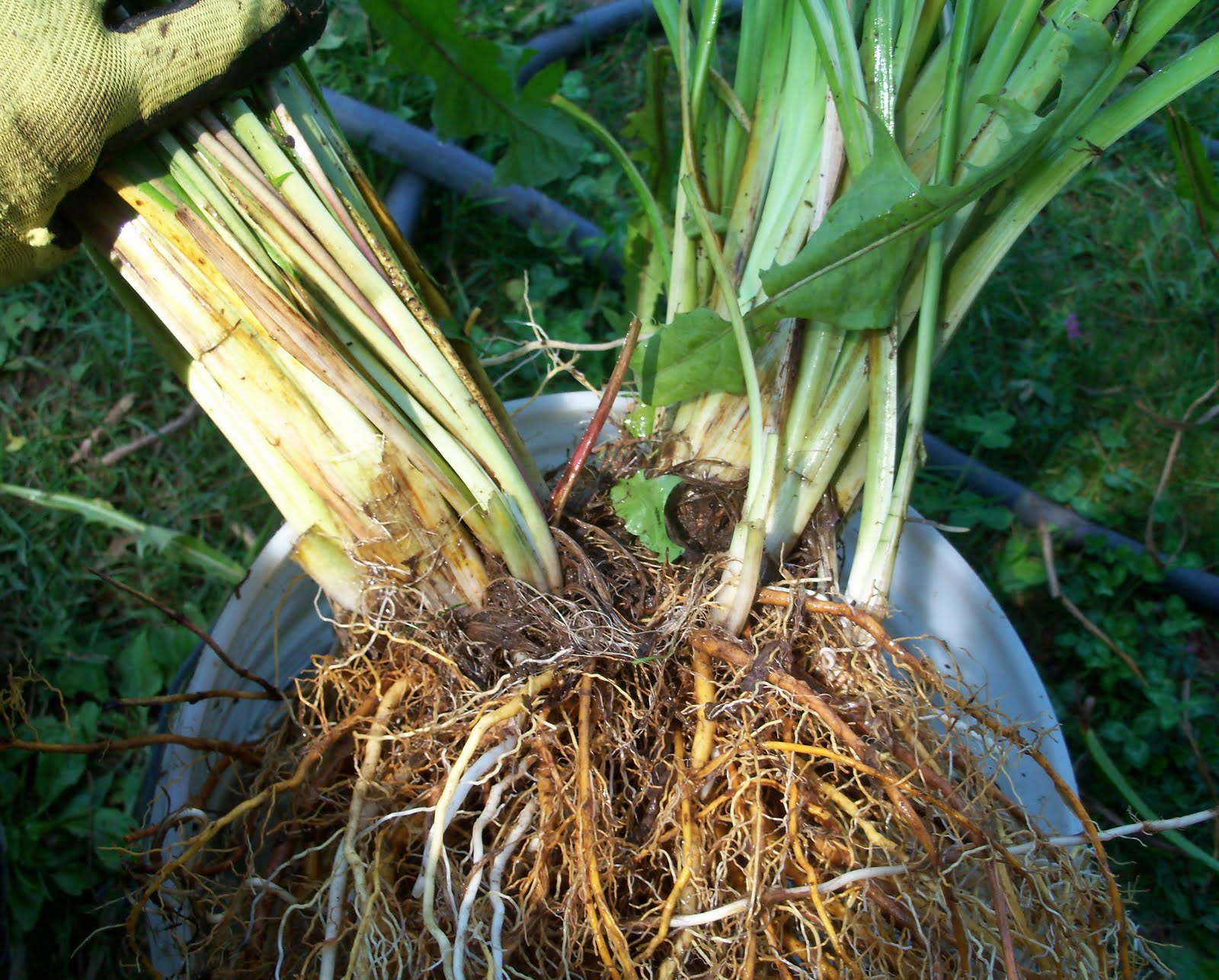
Trimming the foliage back to about 8”-10” makes the clump easier to work with. In this case, I’ve got a good-sized dandelion growing in the middle of the clump … I want those leaves intact so that I can locate that dandelion and pull the whole thing out as I divide.
If you’re lucky, the dirt will fairly easily shake off the root clump. More often, though, a good soaking and swishing in a bucket of water will do the trick, or laying the root clump on the ground and hosing the dirt off.
Now comes the fun part: dividing that tangled ball of roots! Have a game plan in mind: are you simply dividing this clump into two or three smaller clumps? Are you hoping to end up with a smaller clump for yourself, and some single or double fans to give away? Keep your plan somewhat flexible, though, to accommodate the realities of what comes next.
Some daylilies divide so easily, while others are like a diabolical giant hairball. Your goal, of course, is to keep crown and roots intact while disentangling; hold at the base of the plants and try to gently work them back and forth repeatedly to loosen. Sometimes I use a digging fork, or my fingers, to gently pry them apart to start the process. Back and forth, up and down, round and round … sometimes this process becomes less gentle and a little more forceful. Keep in mind that the more force you use, though, the more likely it is that a crown can snap off. Not the end of the world, for sure, but not what you’re shooting for here.

And once in a while, a root ball is just so impenetrable that it seems to be held together with super glue. In that case, you can take a sharp knife to divide. As long as a plant still has roots attached, it should be okay. Some folks prefer to bypass the untangling method and go straight to cutting – you can too, if you wish, but you’re losing some roots that way, and I always think it’s better to leave them intact whenever possible.
So here are ten divisions from this one clump; in all, there are 17 fans. You can see that some of these divisions have more than one fan. I've divided them out this way because I'm "lining them out," typical of a nursery -- hopefully each of these divisions will increase by next summer. The largest division, though, will go into one of my gardens in my yard.

Once you’ve divided as much as you’d like, place the divisions in a bucket of water until they’re replanted, or given away. And when replanting, I like to add some rock phosphate to the soil to encourage root growth, or some organic fertilizer that’s strong in phosphorus (the middle of the three numbers you’ll find on fertilizer packages … as in “4-10-4;” this is NOT the time to use a high-nitrogen fertilizer, as that boosts foliage production).

How long can you keep them in that bucket of water before you put them into the ground? I’m embarrassed to tell you how long I sometimes wait! Suffice it to say that several days of soaking won’t harm your plants, as long as you keep that bucket in the shade; but logically, the sooner you plant them, the better. Yes, there are many tales in the gardening world of daylilies ripped out and thrown onto the compost pile that bloom the next summer, bare roots and all, but you may not want to take those kinds of chances!

Once the ground has truly frozen, it’s not a bad idea to put some mulch around your divided daylilies; anything organic, like bark mulch, chopped leaves, straw, substances that will eventually break down and decompose and enrich the soil. And then pray for a good blanket of snow – exactly the protection our daylilies like best!

Saturday, August 13, 2011

Sow Your Own! -- Part One


Are green pods appearing on top of some of your daylily scapes, once the blossoms have dried and dropped away (or, if you’re a properly fastidious gardener, after you’ve deadheaded)? These pods contain seeds; if you’re feeling adventurous, why not try planting a few? Following some simple directions should produce some surprise-package new daylilies, and with a little luck, you might have a few that you greatly admire.

Here in Part One, we’ll go over the basic realities of how these seeds came to be, and how to gather and save the seeds. Part Two will give step-by-step directions for sowing and growing.

Without getting into Botany 101 too deeply, basically you need a “pollen parent” and a “pod parent” to make daylily seeds; or, if you like, a papa and a mama ;-). The pollen from one must fertilize the other, resulting in a seed pod. Just like human babies, or puppies, or kittens, each fertilized seed will produce something new – NOT a carbon copy of either parent, but a combination of their genes. If you want a carbon copy of a daylily, you must divide it at the roots.

Now if you have only two kinds of daylilies, it’s pretty easy to figure out who the “parents” are! But the more daylily types you have, the more the possibilities for combinations. When you leave pollination up to chance – meaning wind or bees carrying the pollen from one plant to another – you only know who the pod parent is. Deliberate hybridizing allows you to control both variables, but that’s another blog post, sometime down the road. Today we’re talking about the “surprise package” seed pods.

First of all, wait until the pods dry and turn brown. Once a small crack appears, usually at the top, you can remove the pods and empty the seeds out – but make sure that it’s a dry day, and that the pods are dry. A sunny afternoon is perfect. Place the seeds in a saucer, or on a piece of paper, in a dry airy room out of direct sunlight; leave them there for a few days to make sure all external moisture is gone.

Personally, I like to know which pod parent has produced which seedlings, and so I label little envelopes with the pod parent’s name, and place the dried seeds inside. (You may not be so picky, or may not be planting as many seeds, and so this step might not matter to you.) Either way, place the envelopes, or just the seeds themselves, into a plastic zip-lock bag, seal it, and put it in the refrigerator. It’s going to stay in the fridge for weeks, to mimic the effect of winter cold on seeds that would have otherwise dropped onto the ground.

More to come.

Monday, August 1, 2011

What's in a Name?


Have you ever purchased a daylily just because of its name? Or maybe the name was just enough to sway you into a “yes” or “no” decision? With nearly 70,000 registered daylilies out there, and many more unregistered (or “garden names,” as they’re often called), the names range from funny to ethereal to well, downright uninspiring.

Folks have named their hybrid daylily creations after books and authors (“Moby Dick,” “Gulliver’s Travels”), movies and movie stars (“Star Wars,” “Lion King”), musicians and other celebrities (“Tupak Amaru”), politicians and their spouses (“Abraham Lincoln,” “Betty Ford”), places (“Baffin Bay Beauty,” “African Midnight”), desserts (“Caramel Fudge,” “Peach Pudding”), and drinks (“Pina Colada,” “Mulberry Wine”).

Then there is the always-popular and yummy-sounding category of pie names: 73 of ‘em registered – from “Apple Peaches Pumpkin Pie” at one end to “Windham Cherry Pie” at the other. Not sure why daylilies and pie seem to go hand-in-hand, but there you are.

In another common category, daylilies are often named after people unknown to the rest of us – someone’s mother, father, grandparent, child, grandchild – you get the picture. While this certainly has great meaning to the person thus honored, these names usually don’t inspire us one way or the other. At least they don’t do it for me, except for the ones named after great hybridizers.

There’s also the names that, to my mind, are sort of generic and formal; I have some of these – “Crown Royal,” “Royal Heritage,” “Benchmark.” These sound to me like names of dinnerware or flatware sets, but they are attached to very beautiful blossoms.

And if you search for a name beginning or ending with any of the daylily colors, of course you will find plenty: 619 names that begin with “Pink,” and 334 that end that way. At least those names give you some clue about the flower itself.

My favorite category is the unusual/humorous/downright odd names (and if you know me personally, you’re probably thinking, well, THAT figures!). “Auntie’s Lipstick Kisses.” “Big Boy Bubba.” “Oliver Dragon Tooth.” “Cathy Cute Legs.” And the first truly odd daylily name I ever ran across: “Nekkid Woman on a Tractor.”

But would you buy that last one? Or the one called “Varicose Veins?” Or “Butt Ugly?” Or "Weber's Litterbox?" Yes, those are registered daylilies too! … I have to admit those names would stop me in my purchasing tracks. They'd have to be mighty beautiful to overcome those names.

This fall we’ll be dividing and lining out some of our three-year-old seedlings and putting names to them. It’s fun to come up with new names, but surprisingly difficult at the same time. It’s got to feel like it fits the flower. So far we’ve decided on these: “Berried Treasure,” “Dulcimer Music,” “Voodoo Science,” “Santoshi,” and the best one – “Princess Zippy,” for my favorite 5-year-old. See? – I’m doing it too! (And yes, that's it at the top of the post! She picked it out herself!)

Sunday, July 24, 2011

If You Are What You Eat, I'm Feeling Chicken


If you’re a vegetarian for moral reasons, you may as well stop here; this won't be to your liking. I used to be one of those, but even after nearly two meat-free years, I still craved meat desperately … and eventually came to the conclusion that it was what I needed.

Yet I still wrestle with the whole idea that another being’s life is ended so that I may eat it. And I’ve always wondered if I could actually do the deed myself, honestly facing the reality of my choices. Too many people think of meat as something that simply appears on a Styrofoam shrink-wrapped tray at the supermarket, unaware of the issues that swirl around the cruel and inhumane practices of factory farming, the medicated and GMO-derived animal feeds served up, the growth-enhancing hormones injected, all of which, of course, eventually affect our health as well. Not to mention the environmental damage that results.

Anyway, we’ve kept laying hens for years, and have had some of them butchered for us by a farmer friend when they got old. So easy, shipping them off and getting them backed all nicely plucked, bagged, and ready for the freezer; but of course, old hens are really only good for the stewpot.

This time, we’ve got meat birds. Twenty-four of ‘em, all eating like little pigs, so much so that you can nearly sit and watch them grow bigger. It only takes twelve weeks until they’re ready for Freezer Camp – they’re bred to be voracious eaters. Freedom Rangers, they’re called, and although that sounds like they are card-carrying members of the Tea Party, they are a French breed. Vive la Liberte.

It’s a weird experience for me. I have a sort of affection for my laying hens, my “girls.” They’re greeted with, “Hello, ladies!” in the morning; some run up and squat to get patted; they get “treats” of watermelon rinds and cabbage and all manner of good scraps. I always thank them when I collect their eggs, which may sound a bit woo-woo, but I’m expressing my gratitude to the Universe in general for the goodness of these fresh eggs for our table. But these meat chicks … well, I’m keeping my distance, in a way. Just a general “Hey, kids,” when I approach to give them more food and water. Of course, I don’t want to get attached to them, or find them too cute or endearing … and truly, they are helping in this regard, being a mob of semi-crazed fowl who rush any human in a frenzied manner and try to peck your hands and gobble your feet (even though they have plenty to eat in their feeder). It’s just their nature, single-minded eating machines that they are.

So they are enjoying the sun, the fresh air, the grass and bugs, the space to run around ... for another six weeks or so.

And so the question looms, unanswered so far: will I be brave/honest enough to help with the butchering this time? I think of the generations of women all over the world, stretching way back in time, who have very matter-of-factly killed a bird for the dinner table more times than they could count. I’ve cleaned and plucked before; it’s the actual taking of life that, well, I don’t know if I can do. I can’t even watch a needle going into an arm for a blood test. It’s going to be one of those Face Your Fear and Do It Anyway experiences, I think. We’ll see. Six more weeks …