Monday, August 1, 2011

What's in a Name?


Have you ever purchased a daylily just because of its name? Or maybe the name was just enough to sway you into a “yes” or “no” decision? With nearly 70,000 registered daylilies out there, and many more unregistered (or “garden names,” as they’re often called), the names range from funny to ethereal to well, downright uninspiring.

Folks have named their hybrid daylily creations after books and authors (“Moby Dick,” “Gulliver’s Travels”), movies and movie stars (“Star Wars,” “Lion King”), musicians and other celebrities (“Tupak Amaru”), politicians and their spouses (“Abraham Lincoln,” “Betty Ford”), places (“Baffin Bay Beauty,” “African Midnight”), desserts (“Caramel Fudge,” “Peach Pudding”), and drinks (“Pina Colada,” “Mulberry Wine”).

Then there is the always-popular and yummy-sounding category of pie names: 73 of ‘em registered – from “Apple Peaches Pumpkin Pie” at one end to “Windham Cherry Pie” at the other. Not sure why daylilies and pie seem to go hand-in-hand, but there you are.

In another common category, daylilies are often named after people unknown to the rest of us – someone’s mother, father, grandparent, child, grandchild – you get the picture. While this certainly has great meaning to the person thus honored, these names usually don’t inspire us one way or the other. At least they don’t do it for me, except for the ones named after great hybridizers.

There’s also the names that, to my mind, are sort of generic and formal; I have some of these – “Crown Royal,” “Royal Heritage,” “Benchmark.” These sound to me like names of dinnerware or flatware sets, but they are attached to very beautiful blossoms.

And if you search for a name beginning or ending with any of the daylily colors, of course you will find plenty: 619 names that begin with “Pink,” and 334 that end that way. At least those names give you some clue about the flower itself.

My favorite category is the unusual/humorous/downright odd names (and if you know me personally, you’re probably thinking, well, THAT figures!). “Auntie’s Lipstick Kisses.” “Big Boy Bubba.” “Oliver Dragon Tooth.” “Cathy Cute Legs.” And the first truly odd daylily name I ever ran across: “Nekkid Woman on a Tractor.”

But would you buy that last one? Or the one called “Varicose Veins?” Or “Butt Ugly?” Or "Weber's Litterbox?" Yes, those are registered daylilies too! … I have to admit those names would stop me in my purchasing tracks. They'd have to be mighty beautiful to overcome those names.

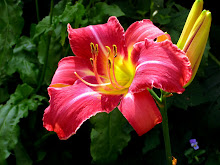
This fall we’ll be dividing and lining out some of our three-year-old seedlings and putting names to them. It’s fun to come up with new names, but surprisingly difficult at the same time. It’s got to feel like it fits the flower. So far we’ve decided on these: “Berried Treasure,” “Dulcimer Music,” “Voodoo Science,” “Santoshi,” and the best one – “Princess Zippy,” for my favorite 5-year-old. See? – I’m doing it too! (And yes, that's it at the top of the post! She picked it out herself!)

Sunday, July 24, 2011

If You Are What You Eat, I'm Feeling Chicken


If you’re a vegetarian for moral reasons, you may as well stop here; this won't be to your liking. I used to be one of those, but even after nearly two meat-free years, I still craved meat desperately … and eventually came to the conclusion that it was what I needed.

Yet I still wrestle with the whole idea that another being’s life is ended so that I may eat it. And I’ve always wondered if I could actually do the deed myself, honestly facing the reality of my choices. Too many people think of meat as something that simply appears on a Styrofoam shrink-wrapped tray at the supermarket, unaware of the issues that swirl around the cruel and inhumane practices of factory farming, the medicated and GMO-derived animal feeds served up, the growth-enhancing hormones injected, all of which, of course, eventually affect our health as well. Not to mention the environmental damage that results.

Anyway, we’ve kept laying hens for years, and have had some of them butchered for us by a farmer friend when they got old. So easy, shipping them off and getting them backed all nicely plucked, bagged, and ready for the freezer; but of course, old hens are really only good for the stewpot.

This time, we’ve got meat birds. Twenty-four of ‘em, all eating like little pigs, so much so that you can nearly sit and watch them grow bigger. It only takes twelve weeks until they’re ready for Freezer Camp – they’re bred to be voracious eaters. Freedom Rangers, they’re called, and although that sounds like they are card-carrying members of the Tea Party, they are a French breed. Vive la Liberte.

It’s a weird experience for me. I have a sort of affection for my laying hens, my “girls.” They’re greeted with, “Hello, ladies!” in the morning; some run up and squat to get patted; they get “treats” of watermelon rinds and cabbage and all manner of good scraps. I always thank them when I collect their eggs, which may sound a bit woo-woo, but I’m expressing my gratitude to the Universe in general for the goodness of these fresh eggs for our table. But these meat chicks … well, I’m keeping my distance, in a way. Just a general “Hey, kids,” when I approach to give them more food and water. Of course, I don’t want to get attached to them, or find them too cute or endearing … and truly, they are helping in this regard, being a mob of semi-crazed fowl who rush any human in a frenzied manner and try to peck your hands and gobble your feet (even though they have plenty to eat in their feeder). It’s just their nature, single-minded eating machines that they are.

So they are enjoying the sun, the fresh air, the grass and bugs, the space to run around ... for another six weeks or so.

And so the question looms, unanswered so far: will I be brave/honest enough to help with the butchering this time? I think of the generations of women all over the world, stretching way back in time, who have very matter-of-factly killed a bird for the dinner table more times than they could count. I’ve cleaned and plucked before; it’s the actual taking of life that, well, I don’t know if I can do. I can’t even watch a needle going into an arm for a blood test. It’s going to be one of those Face Your Fear and Do It Anyway experiences, I think. We’ll see. Six more weeks …

Sunday, July 3, 2011

Another week, and they'll be ready ...


Choosing when to open to the public for the season, when it’s mainly about one kind of plant, is at best an educated guess. Sure, we also have a nice variety of potted perennials that are good companions for daylilies (and the blue veronicas are starting to bloom, the echinaceas not far behind), but really, most folks come for the main show. And the whims of Mother Nature determine when that show starts.

The planned opening date for this year was, well, today. By this time last year, there were 29 cultivars in bloom, not a huge number but showing enough variety to get started. This year’s different; although the spring rains have encouraged the growth of so many scapes and buds that we know the show will be spectacular, the cool temperatures have delayed the opening of those buds, and at present there are only 12 registered cultivars in bloom, most of them showing only one blossom so far.

So all week we’ve been on the fence; to open, or not? Imagine seeing a sign for daylilies, stopping in, and finding only a sea of foliage! Today’s forecast of thunderstorms finally tipped the scales; next Sunday will be the first official Open Day, and we’re sure to have a sea of blossoms by then.

BTW, that's a group of "Bubbly" at the top; the first one just opened this morning. (so yes, the photo's from last year!)

Wednesday, June 29, 2011

Welcoming the Earlies


If you love a particular kind of flower, you often wish that its season would last longer so that you can enjoy it all summer. Daylilies are most often a July flower, and so we fans wait patiently through the parade of the beautiful spring and early summer blossoms, the tulips and peonies and irises and all the others, keeping track of the progress of our scapes and buds.

More and more hybridizers are focusing on season extension, both on the front and back ends; some nurseries specialize in these types of cultivars. We’ve been trying to acquire more of these Earlies and Lates, ultimately hoping for a June-to-September daylily garden.


This year, an unexpected delight: two of our first 2010 seedlings opened as Earlies, one of them the first post-Stella daylily and a red-purple one to boot. Most early daylilies seem to be in the yellow-orange range, so this was doubly pleasing. To add to our pleasure, both of these seedlings are keepers: nice form, good increase, branching and bud counts (especially for first-year seedlings), and opened very well. Neither of them breaks new ground in the daylily world in terms of color and pattern, but that’s fine; we’re just trying to grow new hardy daylilies with beautiful faces that will thrive in Northern gardens.

The first one pictured, red-violet, is a cross between Intelligent Design and Sailing at Dawn; the second, buttery gold with the cranberry eye, is the offspring of Hold Your Horses and Brown Lasso. After they’re done blooming, they’ll be moved out of the seedling bed and into a “keeper” bed, where they’ll be evaluated for another year, to see how they handle being moved and how well they continue to increase. Then, if all goes well, they’ll be available the following spring. It’s a long process, one that forces me to be patient. But the rewards of seeing these beautiful new blossoms for the first time makes it all worthwhile!

Friday, June 17, 2011

Simple Spring Salads


A change in the weather back to cool temperatures here may not be good for newly-planted tomatoes and melons, but it’s been just right for extending the spring salad season. Lettuce grows really well for us here, and so we plant many types, staggering the sowing so there’s always something ready. After growing up in an iceberg-only home (was there any other kind available in the grocery stores back then?), the seemingly-infinite number of varieties available is amazing … and of course I end up buying way more seeds than I can ever use. Some favorites: Blushed Butter Cos, Red Sails, Buttercrunch, and Olga Romaine.

Nonetheless, lettuce is just the start. At this time of year we’re still adding sorrel (but we’re getting to the end of that now, as it sends up its seed stalks), dandelion greens, salad burnet, spinach, violet leaves, chives, baby kale, and tossing in bits of oregano, thyme, lemon balm, whatever appeals at the moment. There’s lots more out there that could be used, of course, but a quick run through the garden in the morning provides plenty for the supper salad. With all those interesting flavors, there seems no need for anything beyond a tasty homemade dressing.

Looking ahead, as the weather gets back to summery steam, I’m now sowing more heat-resistant Batavian varieties of lettuce. They’ll go in a section of the veggie patch that gets some afternoon shade, and maybe we’ll put some row cover over them as well to help mitigate the heat. Batavians have thicker leaves and a different texture than the spring lettuces, and while I prefer the spring greens, we’re happy to have fresh-picked lettuce all summer long.

Wednesday, June 1, 2011

Trees

Trees always seemed to me to be outside of the world of gardening … at least, my world, I guess. Oh, they’re all around, and particularly beautiful in spring bloom or fall colors, but mostly I thought of them – when I thought of them at all – as either 1) something to keep my sun-loving plants away from, or 2) creating shade gardens that seemed particularly challenging. Oh, and 3) expensive to purchase, and therefore out of my budget range.

Now I’m becoming increasingly entranced by trees. There are the utilitarian ones I’ve planted over the years – apples, for instance; the more I learn about them, and the whole subject of grafting onto root stock, the more intrigued I am. We inherited a number of ancient apples with this farm, totally neglected for years; they look like venerable elders to me. One in particular, way out in the back field, is so battered, scarred, and split open that it’s hard to believe it’s still alive … but not only is it alive, but still blossoming and bearing fruit.

This tree makes me think of several people I know who are in their 90s, still vital and engaged with life … as if they’re all saying, hey! I’m not done yet!

Several years ago I joined the National Arbor Day Foundation, after getting one of those offers in the mail … I think it was $15 to join, and they’d send a dozen or so young trees. Twigs, was more like it; a small bundle of the most unimpressive little sticks with bare roots, which seemed utterly ridiculous to me at the time. But I followed the directions and planted them in a nursery bed.

It’s been perhaps five years now, maybe six; nearly all have grown, and have been moved to various parts of the yard. And a few of them have done astoundingly well. Here, for example, is an Eastern Redbud that I transplanted two years ago into one of my gardens… and I left the mower in the photo for perspective.

I love to wander through garden centers and nurseries, looking at the trees; but the price tags are still prohibitive to me. Wouldn’t it be great if we could purchase a much smaller version, and then nurture it ourselves? My heart’s desire is to plant two maples in our yard, knowing that our 50+-year-old willow is past its prime, and not wanting a totally empty expanse when it goes. But at $150-200 each, maples are mighty pricey! So this spring, I’ve been digging and potting some of the little maple seedlings I find around the edges here; nothing to lose, and if they grow even half as well as those little twigs that came in the mail, I’ll have some nice small trees in a few years.

Sunday, February 27, 2011

Still Learning

When I was a kid, my folks seemed so boringly typical of most of the adults I knew: my dad went to work, my mom stayed at home. They each had a few simple interests outside of their daily routines, but nothing they seemed to pursue with any great vigor. It seemed a simple, slow, and humdrum existence to my young eyes.

Now, it seems, nearly everyone I know has nearly more irons in the fire than they can count. Especially among urban homesteaders who farm on a small scale, or growers who have horticultural pursuits beyond a simple garden, it’s an almost-universal necessity to have an “outside” job or two. I’m squarely in that camp with two part-time outside jobs, and sharing some of the duties of the family coffee roasting business. Of course, the farm and gardens are where my heart lies, along with spending time with my family and friends. The saying “there aren’t enough hours in the day!” pretty accurately describes life for me.

All too often, I feel like I am trying to do too much and not doing anything very well – that’s a familiar feeling for many people, but especially for us ADD folks. Life for us is SO full of fascinating pursuits! SO many interesting things to experience! It’s easy to feel swamped in no time at all, to find that you've eagerly bitten off perhaps more than you can chew.

Of late, I’ve been pondering the role of efficiency. Most particularly, it was on my mind this morning as I was once again shoveling a path to the chicken coop. Uphill. About two hundred feet. A path situated on the north side of a hill, a path that turns into an icy luge run about this time of year that’ll pull your feet right out from under you before you realize what’s happening.

Why, I wondered, did we build the coop up there? Each winter I spend an inordinate amount of time shoveling up a hill too steep for our snow blower, hauling food and water up to the hens, then gingerly creeping back down. We dug into the side of another hill to build our greenhouse, creating drainage problems and difficulties in clearing the snow that slides off the roof into great piles. It’s partially due to the layout of our property, seemingly situated for maximum inefficiency, and partially because of our own inexperience and lack of foresight.

When I began farming eight years ago, it surprised me to find that successful (read: profitable) farming demanded a much higher level of efficiency than I possessed. It’s not a trait that comes naturally to me (which will not be news to anyone who has been in my home), but it’s something that I’ve come to admire in those who are wired that way. Recently I discovered Organizing Solutions for People with ADD by Susan C. Pinsky – and it really did feel like a capital-d Discovery. Here was someone who seems to understand why this stuff is so challenging for some of us, and her ability to work with ADD tendencies is brilliant. Geared to the household, her book lays out strategies and solutions to streamline and simplify some aspects of life and to make them more efficient. Easier. Less time-consuming. Did I say brilliant?

I wish I could say that it totally changed my life … but it has made a difference. There are parts of the house, at least, that have been purged and made more efficient and pleasing. And I can look at things differently now. As spring draws closer, I’m thinking about bringing these new approaches to the greenhouse, barn, nursery, and growing fields. But I think I’ll need to reread that book – at least once or twice a year.