Tuesday, May 18, 2010

Lovely little blue invaders


Many years ago … back in the distant past … I visited the Green Briar Nature Center at the Thornton Burgess Museum in Sandwich, MA (http://www.thorntonburgess.org/GreenBriarNatureCenter.htm), and was struck by a carpet of blue forget-me-nots (myosotis) that stretched away at great length under a large old spreading tree. Knowing nothing about this flower, I imagined that this particular bed had probably taken many, many years to reach that size. The blue carpet looked so lovely, and I tucked the memory in the back of my mind, hoping to create something similar some day.
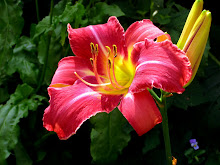
Little did I know how quickly these little gems spread! Several years ago I brought one clump home. Now they have multiplied exponentially, literally choking the other plants in four of my garden beds. I still love their beauty in early spring, but during the last week have had to pull two wheelbarrows full for the compost pile, as well as giving away as much as I’ve been able. These photos were taken after the thinning … the poor daylilies needed some room to breathe.

Tuesday, May 11, 2010


Do you ever get wistful at the start of the school year? Do you remember the excitement of being a kid with a new outfit, a new pencil box, a new teacher? (Okay, maybe I’m dating myself with that pencil box, but you get the idea …)

That’s how I’m feeling right now at the start of Farmers Market season. Having been a market farmer for about five years, and having “retired” from that particular endeavor, I have mixed feelings as I see the opening announcements in the newspapers and the signs on the street. Like most endeavors in life, going to market offered a mixture of pleasure and difficulty; it offered its own little community of growers and vendors, by and large a terrific group of people; and chewed up an enormous amount of time.

Wait a minute, you might be thinking … market lasts for only four or five hours or so, right? Well, that’s how it looks to the customer. But prep begins the night before, with many hours of harvesting, trimming, washing, bunching, weighing, bagging, loading the truck. Starting before dawn on market day, the flowers are cut and made into bouquets, the salad greens, kale, and basil cut, washed, dried, and bagged for maximum freshness. It’s best to arrive at market an hour before opening; there’s the canopy and tables to set up, all the produce to unpack and put out, price tags and bags and scale and cash box (each of which can be forgotten on any given day, resulting in a last-minute scramble). There’s the search for one last cup of coffee before market opens … very important! And then, of course, sending your fresh produce home with happy customers. Seeing the same faces coming back to your booth every week means you’re doing it right.

The aftermath is the hardest part. Bone-tired, you take everything down, repack the truck, and then travel back home; unpack it all, clean out the coolers, put it all away. It’s really more like a twelve-hour day. Lots of market farmers do this twice or three times a week, meaning less time to do the actual farmwork. One farmer friend, who does three markets a week, regularly works in his fields into the night with a headlamp clamped on. More than once, he’s fallen asleep out there.

If market prices sometimes seem higher than the grocery store, don’t for a minute think that your local farmer is getting rich; he or she is likely just getting by, but is offering you the freshest, most delicious and nutritious produce you can find outside of your own garden. One of my favorite bumper stickers says, “Support Your Local Farmer, or Watch the Houses Grow.” Go to market, hit the farmstands, grow your own … it’s all good.

Monday, May 3, 2010

Plant Swap Tonight!


Gardeners seem to be such a generous and open community. It helps that no two gardens are alike, that we are always curious about the blooms behind the fence or around the back of the house, what magical combination of seeds and soil and fertilizer has produced such outstanding lettuce or tomatoes. And when our perennials keep increasing, as they will, we are happy to divide and share.

Here in my little town, there’s an annual “Plant Swap” event that’s eagerly awaited. In early spring, we gardeners gather in the church basement, lugging pots and boxes and various containers holding the surfeit of our spring divisions; the tables will groan under their weight. It’s a little reunion of sorts after a long winter, catching up with one another, making new acquaintances; it’s especially gratifying to see new young homeowners eager to fill out their gardens, and even younger people with a budding interest in growing (pun intended – sorry!).

With great humor in some cases, each person will take their turn offering their plants one at a time – describing the name, color and habit and preferences, if known; once in a while, someone will admit, “I have no idea what this is, but it’s got a pretty flower.” There’s nearly always someone who can identify it. And usually there is more than one person who wants to adopt the plant in question, which requires the use of slips of numbered paper and a hat … this is all prepared ahead of time by the wonderful ladies who put on the event, and results in cries of joy by the winners and a feeling of being at a bingo game.

Me, I’m always looking for the daylilies, of course, but I’ve come home with peonies, daffodils, scented geraniums, Jacob’s ladder; I seem to bring the usual things to give away every year, worried that everyone’s already got them by now, but they’re always happily taken. Then the search is on for some little space in an already-overcrowded garden where the new treasures can be tucked in. Even better, though, is the expanding sense of community that we share, the opportunity to meet new folks and get to know the not-so-new ones a little better.

Friday, April 30, 2010

In the beginning ...


There are casual daylily fans who have a few Stellas or ditch lilies here and there in their yards; there are daylily obsessives, who grow many hundreds or thousands in meticulous showcase landscapes, know the names of every single cultivar they own and many they don’t (yet), and spend upwards of a hundred dollars for a single newly hybridized cultivar.

And then there’s everyone in between (probably the majority of us). I suppose most of us start out with having our eye caught by a particular blossom or two; for me, it was driving past a little daylily nursery farm on a narrow winding road on the north side of Cape Cod, years ago. I stopped to look, and that’s all it took.

Such colors! Such variety! Such lushness of foliage, abundance of blooms … I would go there once a week during the season, after getting my paycheck, and buy one or two. It would take me forever to select them; around and around the beds I went, wanting many more than I could possibly afford, trying to narrow it down.

The grower was a very large man named John, smoking and sweating and heaving himself around the beds as he dug up my choices, making me fear that he could have a heart attack at any moment … but his love for the flowers was infectious, his self-deprecating cheerfulness endearing.

I remember his excitement over one daylily in particular named Cookie Monster. He convinced me to buy it before any of the blooms had opened yet, trusting in his description of the multiple shades found in a polychrome. And he was right. It’s still one of my favorites, all these years later.

If you’re a daylily lover, or a collector of another type of plant, how did you get started? I’d love to hear your stories too.

Wednesday, April 28, 2010

Spring showers?


Yep, that's snow ... it's a late-April surprise, especially with the early spring we've been enjoying this year. Mother Nature's way of reminding us not to get too far ahead of ourselves, perhaps. It's coming down thickly as I write this, but it's really just a blip, predicted to turn to rain shortly. It doesn't even feel cold enough to snow out there, and the bird chorus is as cheerful as ever.

Here in Zone 5, our last average frost date is May 22. If my gardens had a southern exposure, or were somewhat protected, or in town in the valley where it's usually about ten degrees warmer than here, I might be willing to set out tender seedlings as early as some do; but this snow reminds me that here in the hills, things are much more variable. The spinach and kale will be fine, but we'll go up the hill to the field later to check on the lettuce seedlings -- with fingers crossed.

Friday, April 23, 2010

Dividing hostas step-by-step


So many of us who grow daylilies have hostas as well. They don't automatically go together, if you think about it -- daylilies do best in sun, and hostas are generally shade plants -- but there you are.

Spring is the best time of year to divide our too-big perennials, and hostas can present a real challenge once they get large: the roots are thick and tough.

A few years back, my friend Deb clued me in to using a drywall saw to slice through hosta roots, and this works beautifully. A drywall saw can be found in any hardware store and is usually less than $10; and if you don't leave it outside to rust (I plead guilty), it will last a long time.

Here's a series of photos to give you visual step-by-step instructions:

1. The aforementioned handy-dandy drywall saw

2. With the drywall saw, slice into the roots to make as large a division as you want. Some of my garden beds have lots of little stones (I live in the Granite State, you know ;-), and that can present a challenge in itself, but I have yet to break a sawblade.

3 & 4. Then with a spade (a transplanting shovel works really well), dig that division out.

5. The piece taken out, ready to be planted elsewhere.

If you like, that division can be divided again into smaller chunks; as long as you have a few healthy shoots with good roots, it will grow.

Fill in the hole, of course; plant your division(s) and water in well.
You're done!

Monday, April 19, 2010

with a little help from my friends ...

My friend Emily has her hands full. Beautiful new baby, full-time work, big old house built a few centuries ago, lots of gardens. Being much more practical than I, she decided to convert one of her large perennial beds to vegetables this year, and asked if I'd like to be the lucky recipient of about a dozen clumps of unlabeled daylilies of various colors and origins.

Yes, indeed!

So now there is a new perennial bed in front of the house (in addition to about a dozen others -- part of my secret plan to incrementally eradicate the lawn -- ssshh, don't let my husband in on this!). These new daylilies will be unknowns in terms of colors/names/growing habits, and until they blossom I won't know if I've placed the tall ones in front of the shorter ones. But they'll be a lovely sight, nonetheless.